An Experience of Seeing, such generosity.
Ghost River Dam/Bow River
Aspen Reflections in the Bow River
Wishing seeds, Bow River
Snake being Snake

Your Custom Text Here
An Experience of Seeing, such generosity.

Ghost River Dam/Bow River

Aspen Reflections in the Bow River

Wishing seeds, Bow River

Snake being Snake

Morley, Alberta
This morning I rise remembering yesterday when I found a place to rest my body, to witness the world and my relationship to it.
I’ve been thinking about generosity. Clearly. This is the fourth blog post with the word generosity in the title!
How do I give? I wondered. What is being asked of me? When will I know what action to take?
After canoeing adventures which left me breathless, unmoored, in the throes of uncertainty, I’m finding pieces of my identity floating all around me.
I spent most of the afternoon yesterday trying to stay with the unease of this body. My mother came to me. We wept. We loved one another. We remembered some painful events. We remembered our love. I grasp, now, at words to explain what I mean, to share my experience. This is how I live with a broken heart.
I’m aware how cautious I am to share. I’m aware how, in all my uncertainty, this is an action, an experiment, I believe is worthy. I want to point to reality. Again and again.
As a child I tried to speak out, to tell the truth about what was occurring, had occurred. My truth was not palatable. My truth revealed a great chasm. Some truths are too painful to see, to look at, to acknowledge. Forty-four years later, I received the acknowledgement I’ve been seeking since I was nine years old. I was already free from harm by then. I am waiting to know what to do next. As I wait, I bear witness to the way the world is.
“Bearing witness is not a passive act. It is an act of conscience and consciousness and consequence.” Terry Tempest-Williams
In sharing words and images, I invite collaboration. Collaboration leads to community. In community anything is possible. We are able to see what is revealed. We are able to hold what is revealed. We are able to take action. Witnessing is an active ingredient! To watch fully is to allow our presence to transform.
This is where my imagination dwells.
Presence is a generous act.
Such stillness. Such joy. Such love.

Morley, Alberta

Warriors in stillness. Sun rise.
Sometimes a subject comes into view and we want to revel in it, we want to immerse ourselves in it, we want to endlessly read and hear about it.
So begins my deep dive into generosity. An experiment in generosity may be in my future.
I conduct many experiments. I share a few of them. Experiments help me to track the ways I am aware and awake in the world, without judgement. I am interested in reality. I am not interested in seeing reality as good or bad.
I am curious about serving the world through love.
Good Morning Sun.
I began my sunrise experiment in October 2020 and it continues today. At first, I noticed my impatience. I checked my phone for the exact time of sunrise, again and again. I knew the Morning Star, Venus, was also on the horizon, but I couldn’t spot them. I shivered in the chill of fall mornings and the cold in the winter. I took photo after photo, wanting to capture some beauty for all my trouble.
Some mornings (all of June!) I groaned as I got out of bed, resenting my aliveness at 4:30 a.m..
My walks to a bluff where I had a view of the sun rising were between 10 and 20 minutes long. I added an element of voice and sound to my sun rise experiment on many days. I listened to A Songline for warriors. Meg Wheatley’s Warrior’s for the Human Spirit, A Songline. I wondered how a warrior views the sun rising. I wondered how one person might make a difference in a world where people were so divided.
Over time, I began to embody an unshakeable stillness when I stopped to view the sun. A warm feeling arises in the middle of my belly, a feeling like expansion, like the swelling of a heart in love.
Over time, I began to embody the beginnings of discipline. Discipline, one of my words for 2022, (along with reciprocity and sacred) remains an uncomfortable word and idea. I resist authority. I resist group-think. I resist we-should-all-do-it-this-way-because-this-is-the-way. I don’t judge my resistance. I don’t see it as good or bad.
I experience discipline, now, as self-care. I wonder if self-care leads to serving the world with love? So many experiments to do!
I am learning to be a Warrior for the Human Spirit, one experiment at a time.
How, I wonder, might a warrior for the human spirit experience generosity? How might they serve the world through generosity?

Generosity:
Each day the sun rises.
Wow.
How do I give back?
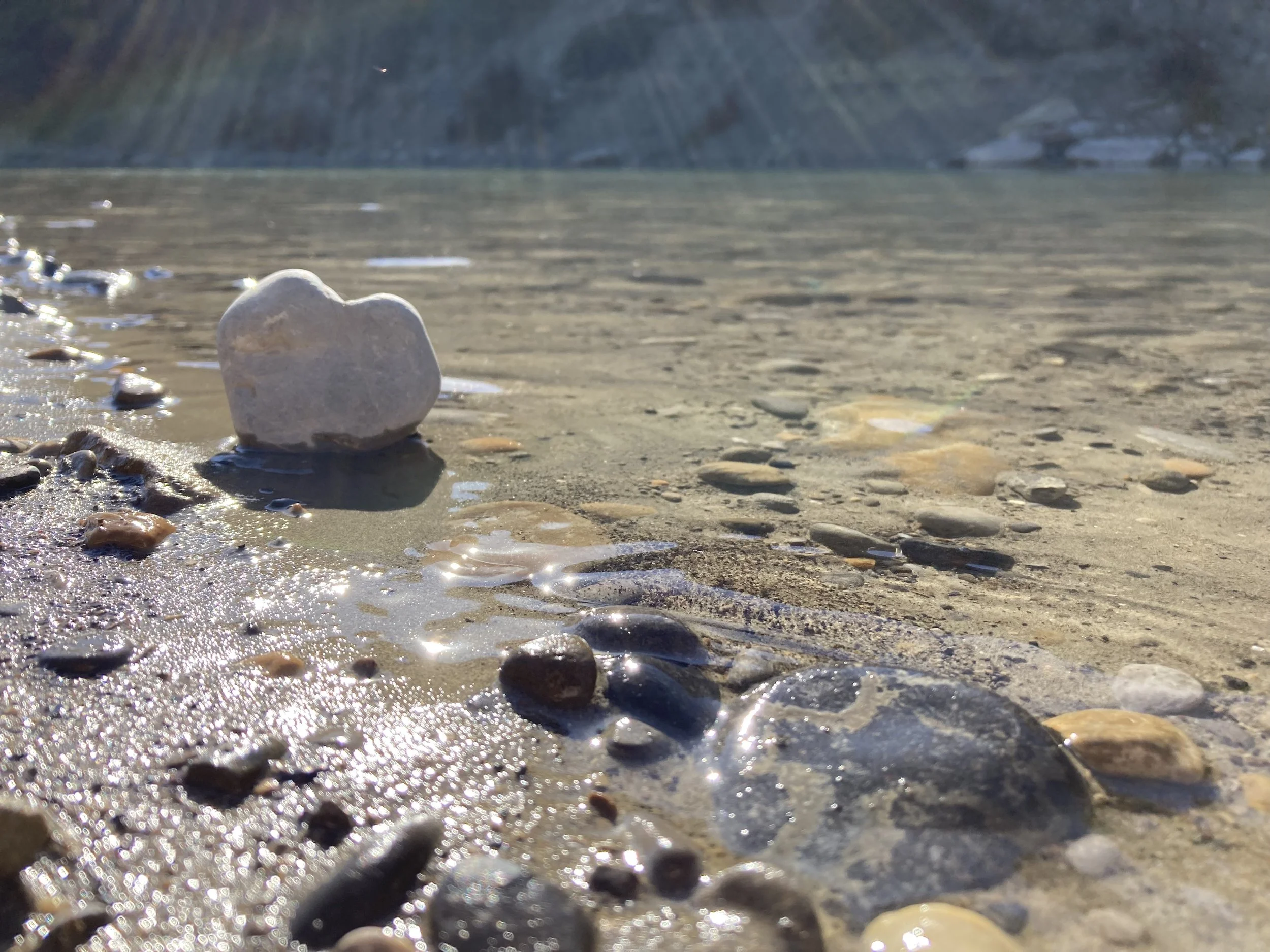
My generosity story begins with a gift.
Tom gave me a rock. A pink and orange and grey heart-shaped rock (one of the most beautiful rocks I’ve seen). I look for rocks. He looks for rocks. Athena chases them into the water.
The day Tom gave me the rock, we walked a wide, smooth-rock-and-pebble beach on Lake Superior. We talked about our joys of the day: the dog (obviously), and being in big mysterious water like Lake Superior (it’s like-an-ocean-big!), and the soundtrack of the birds, the warm spicy smell of cedar all over.. Just to be able to notice it feels lucky. And then, Tom gave me the rock. I added it to my collection. I smiled at his generosity. If I found it, it would be hard for me to let it go. I name objects. My car- Sabine. My hat- Love Hat. My rocks. Sometimes after the people or place they’re associated with. Sometimes the way they seem. I try to get to know them. I make dry riverbeds on my desktop or book shelves, I add them to the garden. I leave them in window corners or on ledges. I wonder what happens to them when they disappear. Where they go. What adventures they have next.
Gift Rock went from Lake Superior (incredible fish and chips and apple fritters) to Sault st. Marie (A Koa built for doglovers) to Wawa (a strangely kitschy and practical general store) to Quetico to Toronto to Montreal (in my pocket while I drove a moving van and my son and girlfriend back to Toronto). The Gift Rock traveled, too, to Lady Evelyn Smoothwater Park (portage country/boulders and waterfalls) through Manitoba (highly recommend the rock history of Meteor Lake) and Saskatchewan (Grasslands National Park- 10/10) to home (Renfrew is a fast-growing neighborhood just north of downtown with incredible bluff views of the prairies to the east and the southwest edge of the Rocky Mountains.)
Gift Rock added to my life. Devotion is powerful. You wish the thing well. You nurture it. You appreciate the beauty. You may ascribe a story to it. Your story may take on meaning. Purpose.
Gift Rock was a very special rock, as I’ve said. I am also aware not everyone would see a rock, shaped like a heart as worthy of so much attention. Focused devotion may veer towards deleterious.
Without harm, I created a place in my heart unlike any I’ve ever held for a rock. I imagined Gift Rock as a piece of a mountain. I imagined mountain-breaking-events- earthquakes, tectonic plate collisions, repeated high winds blasting, ice freezing and thawing and breaking- massive sheets of movement, water, water and more water. Each time I held the rock I remembered a funny or sweet or awe-filled moment of experiences in nature. I imagined Gift Rock holding what I gave it.
Gratitude. Curiosity. Memory.
I didn’t expect I’d let it go.
part 1, concluded. Part 2, coming next.

This morning I rise to an awareness of the future changing.
My daughter and son-in-law travel towards us, back in time from Iceland to Canada, from Toronto to Calgary.
The girls, giggly and buzzing with energy, move from room to room, exploring their world anew, picking up toys and books, putting them down. I look around at the tasks before me; sorting, putting away, cleaning, polishing. A sense of not-now descends. Like a pebble falling into a deep pool of water, I settle with a cup of coffee nestled between my hands. Such comfort, this morning ritual.
I sit in a comfy chair, the sun through the front window projects the shadow of a huge lilac tree onto the floor, the side of the couch. Squirrel shadows jump from trunk to trunk. Athena, full-bellied, sleeps. Tom reads the news on his phone. I remember when this ritual included a newspaper made of newsprint.
I remember back and back to when I was small, my mother’s Maxwell House instant coffee, evaporated milk, and a spoon of sugar ritual. I remember sitting with her while she read the newspaper. Me, with the comics. I feel a warm belly recalling this memory. Comfort. Ease.
Sloane tells me her favourite time of day is sleeping time. Falling into rest. I can relate, more and more to looking forward to night journeys. As I wake, images and symbols come to me and a sense of comfort remains. Gratitude fills me.
This morning ritual of sitting with coffee and the weather of the day is becoming an extension of the night journey. A space of time between sleep and “doing”, a time of “being”.
I wonder when I will add a late afternoon nap to my routine? I wonder if we all, like I did in Kindergarten and Grade One, would benefit from a quiet time, breathing with awareness of the stillness inside?
Tricia Hersey, founder of The Nap Ministry, writes:
This is about more than naps. This is about more than naps. This is about more than naps.
This has been my battle cry and mantra since I created the “Rest is Resistance” framework in 2016. I begin experimenting with rest as a tool for my own liberation and healing in 2013. It has always been about more than taking a full nap. My rest as a Black woman in America suffering from generational exhaustion and racial trauma always was a political refusal and social justice uprising within my body. I took to rest and naps and slowing down as a way to save my life, resist the systems telling me to do more and most importantly as a remembrance to my Ancestors who had their DreamSpace stolen from them. This is about more than naps. It is not about fluffy pillows, expensive sheets, silk sleep masks or any other external, frivolous, consumerist gimmick. It is about a deep unraveling from white supremacy and capitalism. These two systems are violent and evil. History tells us this and our present living shows this. Rest pushes back and disrupts a system that views human bodies as a tool for production and labor. It is a counter narrative. We know that we are not machines. We are divine.
Slowing down. Resting. Waking up to a slow routine, a quiet remembering, may change our lives. How do we make room for quiet? for stillness? What do we do as individuals, couples, families, communities to connect with stillness?
More questions.
Much love, Mar’ce

I rise this morning with Athena. She wants food. She wants to play. It’s too early. The girls still sleep. We can’t wake sleeping children
We cuddle, we sigh, we rest for 40 minutes until we hear the girls waking.
Today is a bunny birthday. Butterscotch and Oreo, the bunnies in the backyard turn one-year-old.
The girls make a maze for them to hop through and they love it! They offer them food treats from the pet store, but they don’t seem to care for them.
They sing Happy Bunny-day to you.
Sloane’s birthday cake- dry porridge mixed with banana and topped with carrot and blueberries? They love it!
The air is full of little girl squeals and giggles. Lots of shouting occurs when they negotiate who is doing what and when. In the kitchen, I clean up and try to listen with curiosity and trust. I do not intervene, though more than once I want to say- quiet, please. I allow the noise to be what it is. I wonder at how difficult it is for me!
Two hours of chaos and bunny love happens.
And then, as if we are paddling in a different river, we move towards drawing and reading. We are quiet.
Change is always happening.
Bunnies, children, Mia (their name for me), Athena. All is okay.

We went to Nose Hill Park, a huge municipal park in Northwest Calgary, a place of many sacred gathering sites for Indigenous people.
Such a generalization, isn’t it? Sacred sites for what? Which Indigenous people? How do I know anything about this?
I trust what I’ve learned from Indigenous people about the history of the land (specifically, this land), about the history of their ancestors. Physical evidence of on-going relationship with the land exists.
Many families visited the medicine wheel at Nose Hill yesterday. I saw them gathering. I gathered with my grandchildren, with my partner Tom. Sloane and Theia, ages 8 and 7, waited patiently during our minute of silence and the placement of a rock Tom gave me when we visited Lake Superior this summer. A heart-shaped rock.
“New beginnings are possible,” I said as I placed the rock. “I will be part of a new beginning.”
If the grandchildren hadn’t been there, we would have lingered. Instead, we moved quickly off the windy high ridge and into a more protected area.
We spotted a garter snake slithering across the path. We climbed trees. We collected colourful leaves. We examined coyote poop. We identified rose hips.
Nose Hill is becoming a place where we gather, too.

This morning I rise at the sound of my granddaughters, Sloane and Theia, awake and in their bedroom, talking to the world through the voices of their stuffed animals. Owls and dragons, and bunnies and bunnies and more bunnies chatter and squeal with delight.
This morning I walk into the living room and see the girls’ orange shirts laid out as school day clothes– today they have their first school assembly for the year. I’ll be in the audience. We’re all aware of the wearing orange shirts at this time of year to show respect and commitment to Truth and Reconciliation with Indigenous peoples. I am aware of the history of Orange Shirt Day, of the truth of residential school harm.
***
This morning my granddaughters eat cinnamon-sugar toast or pancakes with strawberry sauce. They ask me what kids in residential school had for breakfast. I tell them, thin porridge. I describe thin porridge. They are sad to know this is true. They also know the story of Orange Shirt Day.
Phyllis Webstad, 7 years old, proudly chose an orange shirt for her first day of school at Residential School. It was taken away from her at the door. She was given a number and a corresponding shirt which matched everyone else’s shirt. This was a beginning moment for Phyllis. The beginning of harm.
This morning the girls eat breakfast, get dressed and attend to their pet bunnies, Butterscotch and Oreo, who hop out of their hutch to munch on the back lawn of clover. The girls’ bunny love is squeal-y and sincere. I wonder at the contrast between this moment in a 7 and 8 year old girls’ life and Phyllis’ moment.
***
Dear Reader, I do and I don’t know why I’m writing on this topic today. I’m writing on it because my feelings are big, because the truth is in the room with me. I don’t know why I’m writing because I cannot educate anyone. We can only educate ourselves. To be honest, over the past 15 years I’ve been met with much resistance to the truth from settlers.
It is easy to wear an orange shirt.
It is not easy to feel the past and on-going suffering of Indigenous children and their families.
I remember my first-hearing of stories of hunger and starvation from Indigenous peoples who went to residential school. I remember feeling numb at the suffering Indigenous people experienced which began when they were children, at the suffering which continues today through the harm of having children forcibly removed from their parents, language and cultural practices forbidden, punishment justified, neglect unnoticed, horrific abuse allowed, harms hidden from view, harms known and ignored.
***
The school assembly begins with everyone rising and singing O Canada. I understand this choice from a settler perspective. I am unsettled by this choice. I place my awareness in an Indigenous perspective that’s been shared with me: What does it mean to repeatedly honour a country which did not/has not, in fact, stood on guard for Indigenous Peoples?
Waves of nausea crest and break in my gut.
I notice evidence of teachers modelling a willingness to acknowledge and hold truth in meaningful ways. I hear students’ responses to questions as hopeful.
I feel a sense of not-enough.
I remember how difficult this truth is, how many times I experienced parts of it before I began to feel through the whole of it.
***
After the assembly, at home, I cry in private. I allow my tears to remain on my face until they dry.
Where do we find comfort when the truth of history is so awful?
I remember reading Anne Frank’s Diary as a young woman, watching Roots on TV. I asked my mother if it was true. I was a sensitive child, prone to crying and lashing out and asking lots and lots of questions. She told me it happened in the past and I didn’t need to worry about it. It was over. She gave me the kind of comfort she knew how to give. Her father had been a green beret in the army, and two of her brothers. Pain-filled truths are often buried.
I took my youngest son Ben to see The Striped Pajamas when he was 11 at the Metro Cinema in Edmonton. When the movie ended (a heart-wrenching scene of a line of human beings walking into a gas chamber) he looked at me and demanded, “Tell me this isn’t true. Tell me it isn’t true.”
“It is true, I told him. Humans harming each other is so true.” We sat in our theatre seats and wept.
Perhaps comfort is not necessary. Perhaps, instead a commitment to warriorship is needed- the bravery to stand still in the face of whatever arises.
***
Dear Reader,
Can we establish in each of our lives a way of seeking the truth and holding still long enough to know the best action to take for a peaceful/honest/trustworthy future of our children and their children, for the future of humanity?
We aren’t just making up for wrongs.
We are helping to create a world where honesty and integrity are foundational to how we live.
***
I’ve been in many Indigenous circles where the moments after the first day of Residential School are given voice. The complex wounds of history reveal the unimaginable, the truth.
I’m humbled by all the Indigenous people who have been patient with me, with other settlers. I understand why some of them choose not to engage in private or in public with settlers. Some of us do not welcome the acknowledgement of truth, this reckoning we call Orange Shirt Day/Truth and Reconciliation Day. Some of us push away the uncomfortableness, refuse to participate, create a backlash of participation. Some of us are afraid of the re-balancing of power which will occur as Indigenous voices are acknowledged and treated with respect.
I’m humbled by the number of settlers I’ve met who have faced the truth. Some of us welcome honesty. Some of us are interested in re-building integrity, investing in compassion, giving what must be given in order for peace among our peoples.
Some of us are curious about Indigenous Ways of Knowing. Some of us find truth in Indigenous Ways of Knowing.
Some of us are suspicious of any way of knowing which is different from what we’ve been taught from our ancestors. Some of us refuse to question our beliefs, our opinions.
***
I grieve this truth, too: we are in a time of deep-division. We are in a time when our hatred and intolerance of the other is visible as we go about our daily lives. No longer do we live peaceable and isolated lives, only finding out how hatred escalates during news hours and news breaks.
Perhaps this is exactly what we need; to not lose sight of what we all have to lose.
***
Most settlers alive through the residential school years did nothing to stop the harm. Most settlers elected successive governments who, on their behalf, perpetuated the harm of residential school, created more harm in all of our society’s systems, focused on defining Indigenous peoples as sub-human, inferior, deserving of harm in order to integrate them into our society or eliminate Indigenous people altogether.
***
Thank you Phyllis Webstad. Thank you to all of your friends, your children, your grandchildren– all the people who helped you find your voice and all those who have amplified your story.
Thank you Adrian Wolfleg for sitting with students from Sunnyside School, for talking about the importance of making friends with all beings- the animals, plants, people in our neighborhoods.
I am humbled by the guts it takes to begin again and again and again.
***
Phyllis Webstad’s Orange Shirt day, now co-opted or honoured (perhaps both) by the Government of Canada in their declaration of September 30 as the National Day of Truth and Reconciliation, may begin another beginning.
So much depends, now, upon an orange shirt.
I rise this morning a 7:45 a.m., the sun is up.
A series of images came into my awareness just before waking: a tree with expansive and far-reaching branches, a wide river, streaks of clouds in a blue sky. Sounds emerged, too: a deep bass sound and the calls of Raven and Chickadee. The colour yellow came. The colour Red showed up.
I miss being outside each day for hours. I miss sleeping in a tent. I miss the sound of waterfalls or a creek churning nearby.
For now, I have work to do in other ways. Soon, I’ll find a balance again. Until then, I’ll visit earth and sky and water in my dreams.
I rise this morning thinking of warriors. Women warriors. Male warriors. Non-binary warriors. I know many of them. I rise this morning looking for inspiration from warriors. I need to make peace.
I don't speak often of the word Warrior, worried I’ll be misunderstood or rejected for being too ________ .
***
Most of the representations of warriors I’ve encountered in film/television media have been embroiled in extreme violence and lots of blood. Years ago, I watched Spartacus, a show which used over 300 gallons of fake blood per episode, (Kill Bill spilled over 450 gallons of tinted corn syrup. On Stranger Things, Eleven, played by Millie Bobby Brown, “bleeds” whenever she uses her special powers.)
I watched Spartacus through a triangle space between my third and fourth fingers. Among many male warriors, three women warriors with on-screen lives battle for survival in Spartacus: Laeta (Anna Hutchison), Saxa (Ellen Hollman), and Naevia (Cynthia Addai-Robinson). Addai-Robinson said of the show’s popularity, "The show is known for the sex and violence but what keeps viewers coming back are the relationships and the love between the characters."
This viewer did not watch the show for the relationships or the love between the characters. This viewer watched three seasons for the physical embodiment of warrior, for an experience of facing what I did not want to believe was true- all the violence, all the justified killing, all the ways we kill each other’s culture. I’ve also watched Game of Thrones and Vikings– often with my hands blocking out sound and/or image. These shows represent the stories of some of my ancestors. I am part them.
Splatter horror is part-art and part-craft. Create a visceral reaction in the audience and you allow them to experience horror from an emotionally secure view. Interesting research– in countries with higher GDP, the consumption of horror movies is higher. Perceived resource scarcity, the study’s authors conclude, lowers the sense of control viewers experience, leading to lower consumption in horror as a genre. From my emotionally secure view, I experienced the violence as separate from me, but I still felt it in my body. I still needed to shield myself at times, comfort myself at others. Rarely did I feel joy in anyone’s victory.
***
I’m confused by the word warrior. Etymology online (a resource I often access) says the word warrior comes from the French: c. 1300, from Old North French werreier (Old French guerroieor) "a warrior, soldier, combatant, one who wages war," from werreier "wage war," from werre (see war (n.)).
A little over 100 years after the word warrior came into use, Joan of Arc, a national heroine of France, led the French army in victory at Orléans in 1429– defeating the English’s attempt to conquer France during the Hundred Years' War. Joan of Arc was a peasant girl who believed she acted under divine guidance.
What choices did the “Spartacus” women have in 73 BC to 71 BC? What choices did Joan of Arc have in 1400? How has our language been shaped by the events of our lives? How does our language shape the current events of our lives?
Could being a warrior (female/male/non-binary) mean something different than “one who wages war” like the portrayals I’ve seen on the screen? How do other cultures define warrior?
Warrior, from the Tibetan word Pawo, literally means one who is brave.
***
Compassion, "feeling of sorrow or deep tenderness for one who is suffering or experiencing misfortune," mid-14c., compassioun, literally "a suffering with another," from Old French compassion "sympathy, pity" (12c.), from Late Latin compassionem(nominative compassio) "sympathy,"
The Tibetan term for compassion is nying je, which the Dalai Lama states, "connotes love, affection, kindness, gentleness, generosity of spirit and warm-heartedness." People with these traits want to help others who suffer.
***
What if warrior and compassion were coupled in a female/male/non-binary being?
All morning I’ve been contemplating this notion.
I experienced a period of anger last night which had my body electrified with a pushing-away kind of energy and my mind racing for a couple of hours. The anger felt powerful. Strong. Piercing. My words did not feel kind or generous or gentle in my body. The reaction of the recipient of my anger, “Why are you being so mean?”
The story I told myself: I was angry at an obstacle in my path-to-being-good and being-seen-as-good. The person I directed my anger towards, and my sincerest apology soon after my outburst, showed up with a compassionate response of love. I felt shame afterwards, and guilt. And gratitude. And forgiveness. I had temporarily lost my ability to discern the appropriate response to my anger.
We beings are capable of so much. Our bravery and our compassion can help define what we do and how we live.
Much real blood is being shed at this moment. Many warriors are in action at this time. Some are blindly waging war, others are facing the truth of oppression/domination/violence with discernment, bravery and compassion.
I’m still at the beginning of this path of understanding. I am not an authority in any way. I’m a questioner. This is my questioning. This is my call out to you, dear reader. I’m interested in listening to your warrior stories and questions. How do you come to be a warrior? What is your physical experience of warriorship?
Many of my ancestors were fighters; French, English, Irish, Viking. They waged war for what they wanted. Some viewed other persons as disposable obstacles to their want. The shame and guilt they also experienced may have created a code of silence. Others viewed other persons as part of a necessary whole to make peace among all beings.
And what do we do now, I wonder, with the way the world is, with the world my ancestors left us, with the world my grandchildren will inherit?
In my first family, we let pain remain unheard, we actively resisted facing painful events and truths. So much shame. Our concealed suffering erupted eventually, like an earthquake, separating some of us from the others.
How does a warrior face suffering with bravery? This is my question today.

Mia and Theia
Sunday afternoon at a playground is a wonderous event.
Theia climbs to the top of the space ship vehicle which, when spun, can travel into the imagination and land wherever we decide to land.
“Mia, come look at the view!” Theia calls.
I climb up to the top, my legs just a bit trembly when I turn out and face the expanse of the sky, the tall trees, the view.
“Hold on.” I caution Theia.
“You don’t understand, Mia,” she says, “The climber is holding me. Look!”
She’s settled her bum on a horizontal rope, fit her body in between the vertical ropes. She is, as she says, held.
“Yes, it appears you’re safe.” I smile.
I think about her awareness of her body in space and in time. I think about my own awareness, growing steadier and steadier. The more I am with the physical experience of being alive, the likelier I am aware, like Theia, of being held.
Our space ship lands in a wonder land where Mias push girls on swings until they are all swung out, where girls sing songs while they swing, where the sun shines the whole time we remain at the playground.
Sunday at the playground. A great view. Big hearts.

The Wisdom Engines are tools for “consciousness hacking”. The metaphysical and ontological ideas regarding the nature of being, existence and truth embedded in these drawings has the potential to disrupt and enliven the general field in which they are experienced. This one is called Riverspine.
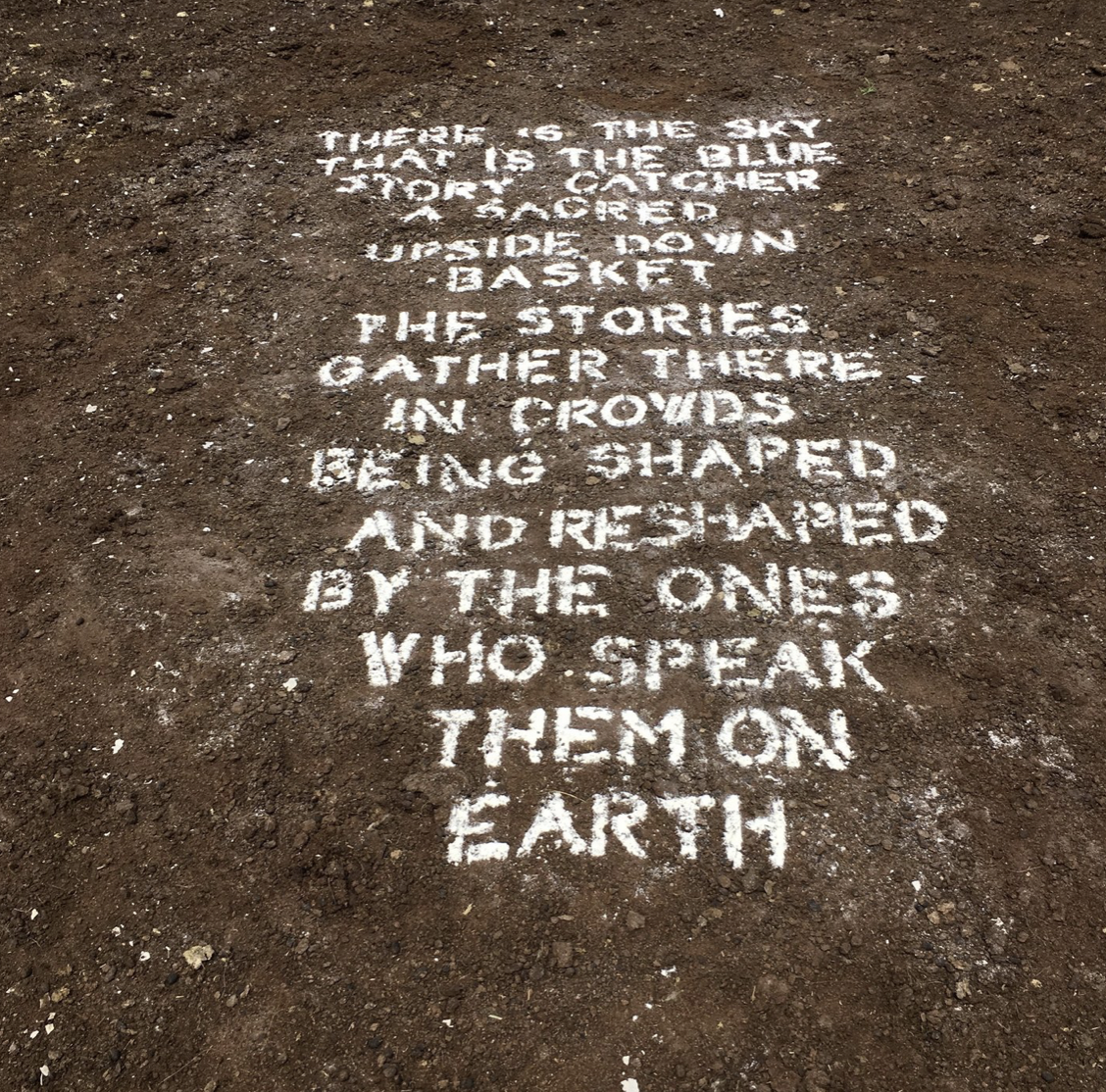
Story Keepers was made in Murun, Mongolia at the invitation of Land Art Mongolia Biennale 2018.
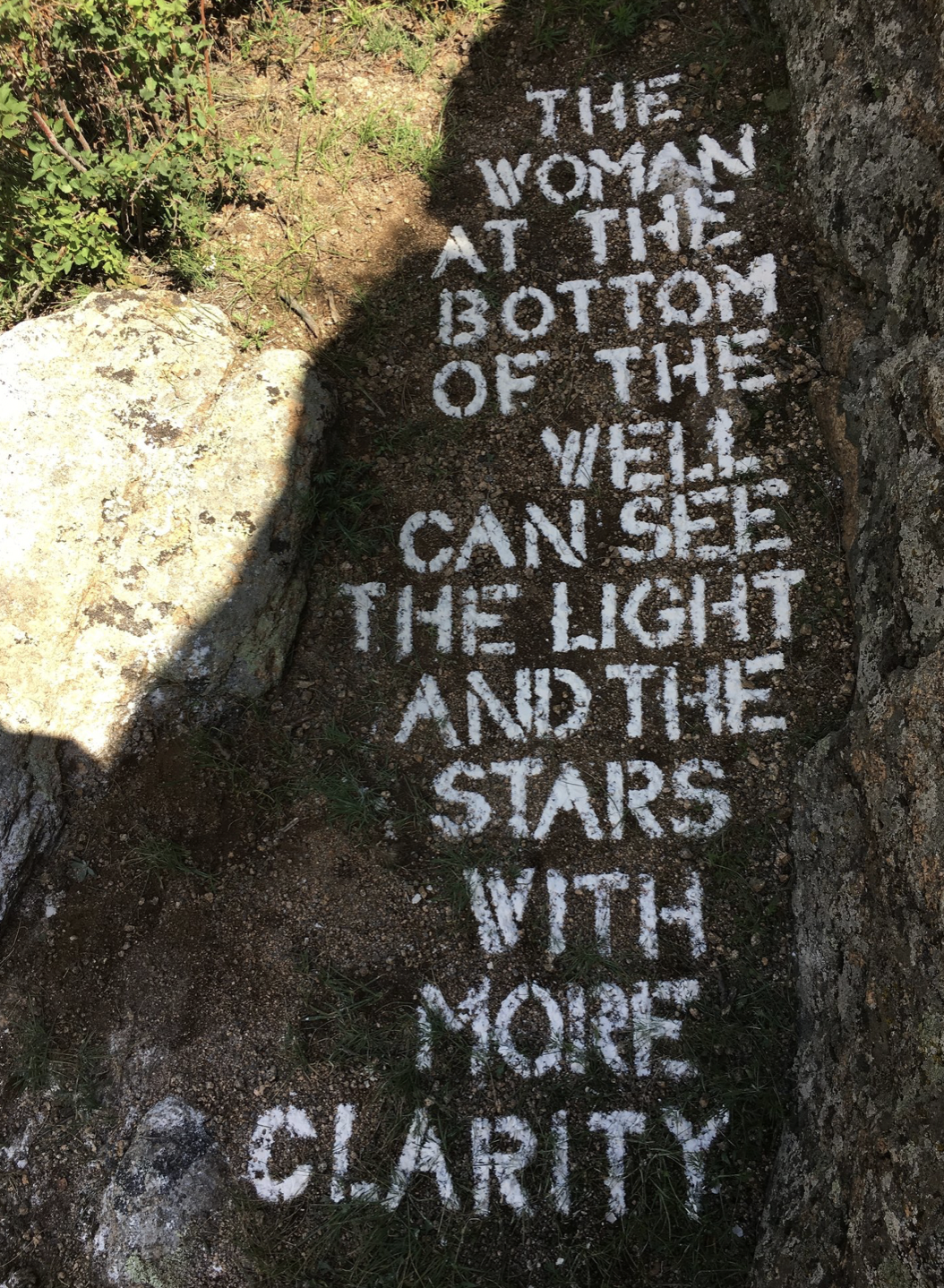
Written on Skin: Concentric Stories was a ceremonial or ritualistic process of writing 7 stories as offerings to and on the land.
This morning I rise at 7 a.m., just in time to watch the sky lighten from near-light to light. Now, the sun sends long shadows into the yard. The air is a kindly-cool. The promise of yellow leaves on trembling Aspen groves comes with the wind. Among the mountains, the Tamarack and Larch seem to gather for a celebration of cooler wind, longer nights– preparing, perhaps, for the darkness of the winter season.
This morning I read Maria Popova’s offerings about a visual artist from Slocan, British Columbia, a region of the world I’ve visited in the summers, enjoying the heat of the day in contrast to the icy cold water– even at the end of August, I last only a few minutes swimming .
Tanya P. Johnson swims in the waters I have dipped into with tremble and shriek. I’ve only discovered her work today and I’m curious. In her bio she writes of sharing her life with a black dog, and says she is “drawn to the random, is fierce about justice, likes foxes and dislikes locusts, sharks and oppression.”
I viewed the pieces of her work I’ve included in this post with quiet stillness. I noticed a warmth in my belly, a waterfall down my back, a smile in my heart.
I wonder your reaction, dear reader?
I wonder your reaction, dear reader?
I wonder your reaction, dear reader?
***
I read, too, an interview with Elizabeth Strout. I devoured her books, Amy & Isabelle and Olive Kitteridge. Here are a few sentences she spoke which speak to me:
“I love to write,” she says simply. “I want to connect with somebody so that they can see their life in a different way even just for two minutes, or have some momentary sense of transcendence, as though the roof were a little higher for a few minutes. And they can look around and they can say, ‘Oh, right, it’s just life, it’s just life.’”
Intent may be everything or it may be a bit of something which propels, which causes a spiral to begin. It may vary with the intender. It may vary with the attention, the attunement, the awareness of the intender.
I wonder, dear reader, your reaction?
I wonder, dear reader, your reaction?
I wonder, dear reader, your reaction?
This morning I rise at 6:30 with Athena’s request (a coughing sound as if she’s trying to find her voice) to get outside and pee. She’s been sleeping in the same room as the granddaughters and now she’s standing next to the front door. I follow her outside. Look out as the day begins.
The sky is dark. A few birds call out.
Back inside, Sloane, 8 and Theia, 7, announce they are still tired and they’ll go back to bed.
In the kitchen, I prepare Athena’s breakfast and offer it up. She eats with gusto. I turn on the countertop griddle. I pour 1.5 cups of buttermilk into the flour/baking soda/salt/sugar ingredients I mixed up 12 hours earlier.
I’ve made hundreds of pancakes in my life. I’ve awakened from sleep thousands of times. I could be on autopilot, really, the way the routine is established.
I notice the sky is lightening. I step outside. The air is fresh. Just a slight chill. Sun touches yellow leaves. The season is turning. I am here.
Sloane and Theia move around me in the kitchen. Our patterns intersect with each other. We hug good morning. We talk about the day. I notice their eyes, the sound of their voices rising and falling like little songs, the aliveness of them. I notice a solid feeling inside me: a calm, a settledness.
I am not on autopilot.
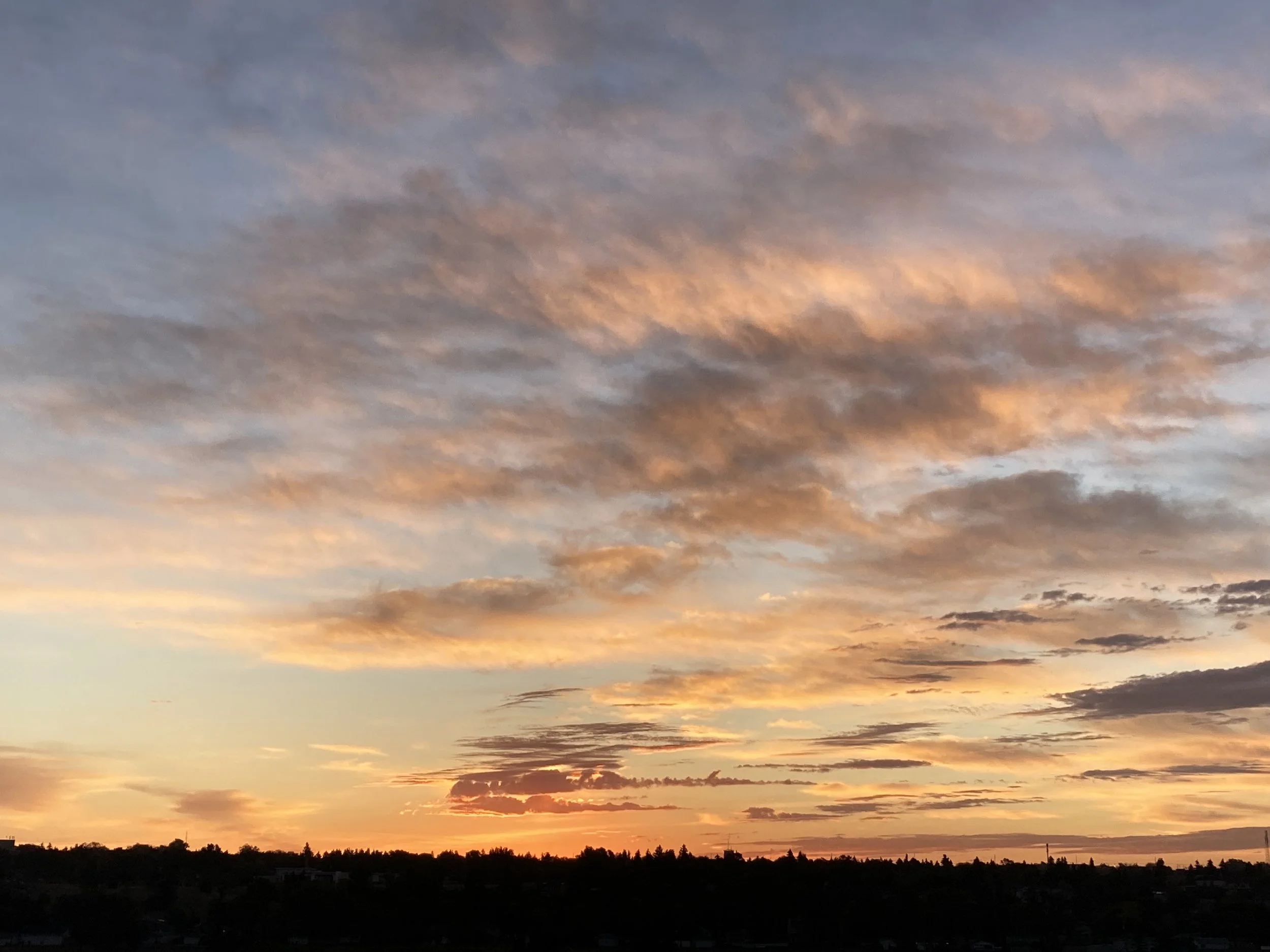
Sunrise Experiment, September 22, 2022.
This is Experiment number 2 of Sunrise documentation.
Experiment #1, Showing Up for the Sunrise, (2020/2021) revealed my capacities for discipline, for deep noticing, for holding uncertainty (when you show up at sunrise, you have no idea what will greet you.)
Experiment #2, Quality of Attention at Sunrise, focuses on how I might attend to the sun rise or the morning hours (if I am unable to walk to see the sunrise because I am caring for someone in my family and my presence near them is needed)
Experiment #2 asks me to consider:
slowing down, (notice, notice, notice)
the act of discernment, (to sift or separate what is noticed; to see the parts)
the experience of compassion, (to hold all the parts as if whole, with kindness, without judgement)
the embodiment of spacious awareness. (to experience the process of noticing in the body)
Hypothesis: Focusing the quality of attention will lead to an expanded perspective.
Hypothesis #2: The discovery of this perspective will disrupt my relationships with all beings.
Hypothesis #3: This perspective will lead to a deeper understanding of one of the three words I adopted for 2022: Sacred.
Thoughts: I’ve written before about my resistance to the word Sacred. Questions I’m holding in a biased mind:: Are the sacred objects carried by Catholic priests objects of terror? Are the sacred pathways of religion actually dangerous odysseys? How is religion different from spirituality?
Procedure: (in development) Stillness. Listening.
Tools needed: (in development) Protection from the elements. Alarm as needed to wake up.
Preparation: (in development) Set out the walking clothes/shoes.
If you’re interested in some details about the photo above and the way my life has unfolded over the last couple of days:
This photo is sunrise documentation from yesterday, September 22, 2022, the day after equinox, the day so much erupted in my life- for about an hour I lived the dragon-of-sorts survival experience through emotional reaction. I’ve written about this experience. So much happened yesterday; I met with Meg Wheatley in a small-ish group over Zoom, I talked with writers who I’ll be working with soon, I talked with my son, Ben, who is in an educational space which suits the way he thinks, the kinds of curiosities he has in life. When he talks about school, it reminds me of my own passion for learning. All day long, I was engaged in reciprocal conversations. And I tried to comfort my guy, Tom, who is experiencing still-undiagnosed and unrelenting mysterious pain in his calf. And, lastly, we stayed up until late in the night, crafting a piece of writing for Andrea and Hap Wilson from Cabin Falls. It’s a memory document of the last day of our paddle out from our stay at Cabin Falls. Today is the second day of the Celtic new year. I look forward to more beginnings.

A Dragon-of-Sorts Sky…
I rise today with the intent of writing my first thoughts. I pick up Mark Nepo’s The Book of Awakening and the September 22 entry asks me to consider a sacred moment.
I look up the word sacred. Again.
Sacred etymology: late 14c., "hallowed, consecrated, or made holy by association with divinity or divine things.”
I chose Sacred (or it chose me) as one of three words for me to carry through the year. I’ve identified many moments during 2022 where the other two, Discipline and Reciprocity have been realized, recognized, placed inside direct experience. Sacred is tougher for me.
I’ve been worried about the word sacred ever since I wrote it down. The word’s association with the church brings up memories for me. Fear. Anger. Betrayal.
I celebrated September 21, equinox, the beginning of the new year in Celtic tradition, in a glorious mess of deconstruction. I found myself navigating fierce anger, a pulse of fear, the shadow of memory from childhood. I stormed about the house at one point “tidying up because it would give me a sense of control over something.” The flow of anger felt so powerful. I wanted to hold onto it.
Anger: Tight jaw, jutting out jaw. Heat all through my body, pooling in my hands and feet. Face, hot. Face, rigid and set. Eyes, unseeing. Heart, shut down. Hearing, limited. Gut, full of flame.
Did I transform into a dragon-of-sorts, protecting something sacred? What was the sacred thing?
The more I talked, the more confused I became. The anger deepened. I could feel the desire to make strong declarations about you=this or me=this. I knew I was headed for real danger. For the kind of danger where you’re blasting out your fiery breath. I could see who I was in danger of becoming. Suddenly, I wanted the anger gone. I wanted to escape and take it with me. I wanted to run. I wanted to shout, “I’m really going now. I really am. I won’t be coming back.” I kept moving. I gathered things. A bag. A book. I fell into patterns I thought I left behind.
And then, I stopped.
I vowed to stay in the spot I was in until the anger dissipated. I became curious about it.
The dragon-of-sorts sought a way through the rough seas, the volcano, the earthquake, the hurricane.
I cried when love broke through the protective barriers I’d set up. When my perspective grew wider, my eyes and ears opened, my jaw relaxed, the heat and tension flowed, I felt my heart. I could communicate again. Through love. Fierce love.
A story of the people and the events might be helpful to illustrate my point, but I also want to point out how narrative can create the conditions for a circling dragon that never leaves. With narrative, I can attach blame or place undeserved disposition (temperament) on a person.
Emotion felt in the larger context is a different awareness than emotion felt in the individual.
I wonder if yesterday, a day for endings and new beginnings was a test for the dragon-of-sorts. Did the dragon attempt to allow whatever emotion existed to be felt, to rise and fall, to erupt and ebb? Is the dragon a reflection of the wider context? And, what is the dragon protecting?
Love? I wonder.
Is love the sacred thing?
Here is a fearful moment I captured on video. Athena is the puppy in our team. We are at Lake Superior. She loves to jump. She loves to catch sticks in her mouth, and carry them, and bring them, and find them. We want to be part of her excitement. We seek out opportunities to be triangulated with her love of sticks.
Each time I watch this video, my stomach turns at a certain moment (if you watch it, you’ll know which one…)
I try to let the fear rise and fall away.
My novel, The Arbornauts, is part horror/part psychological suspense. I didn’t know this was the way this novel would go, but I am interested in the continual facing of fear.
What is your experience of fear? What do you do to avert fear? How do you face fear? What is underneath fear? I’m asking myself these questions. Today. Often.
Athena grabs stick. Loses balance on the descent.
Fear. Fear. Fear.

A collage from a collection. Mar’ce Merrell 2020
I walked this morning in the early-sun-of-the-day with Lidia Yuknavitch’s voice in my head. And David Naimon’s. They talked about Ursula K. LeGuin’s Theory of Fiction as a Carrier Bag.
So much was said by them, so much has been said by others about LeGuin’s Theory and about form and motivation, and the need to tell stories in different ways. I’m still digesting it all and I plan to offer a workshop or a series of writerly experiments to wend our way through form. I’m interested in feminine forms. I’m interested in non-binary forms. I’m interested in the polyvocal.
I’m intimidated, too, because I feel like I’m late to the party and I have purchased a cheap bottle of wine which I hope is a good value and not over-priced-swill.
Athena wanted more of my attention this morning than I gave her, busy as I was with listening to Lidia and David. And, now, as I write this, she is asking for me to take her for a walk. Asking = occasionally jumping up and putting her front paws on the back of my shoulders. I don’t think this is good manners but I understand the urgency of desire.
So…for now…I’ll leave you with a few explorations and a promise to revisit this topic, again and again. LeGuin’s work deserves the revisiting! Here is a quote from her essay The Carrier Bag Theory of Fiction
If it is a human thing to do to put something you want, because it’s useful, edible, or beautiful, into a bag, or a basket, or a bit of rolled bark or leaf, or a net woven of your own hair, or what have you, and then take it home with you, home being another, larger kind of pouch or bag, a container for people, and then later on you take it out and eat it or share it or store it up for winter in a solider container or put it in the medicine bundle or the shrine or the museum, the holy place, the area that contains what is sacred, and then next day you probably do much the same again — if to do that is human, if that’s what it takes, then I am a human being after all. Fully, freely, gladly, for the first time.
LeGuin imagines a novel as a carrier bag. Lidia talks about her work as polyphonic. David brings in all sorts of writers and artists who connect to the idea of what is collected and the shape of the vessel which holds the collection.
I can’t help but think of the collectors I’ve known and what motivates them, what hope they derive from their collecting ways. I wonder how all of this will contribute to my own finishing of a novel I’ve been haunted by for many years, The Arbornauts.
More later. See you soon. Mar’ce xoxoxo
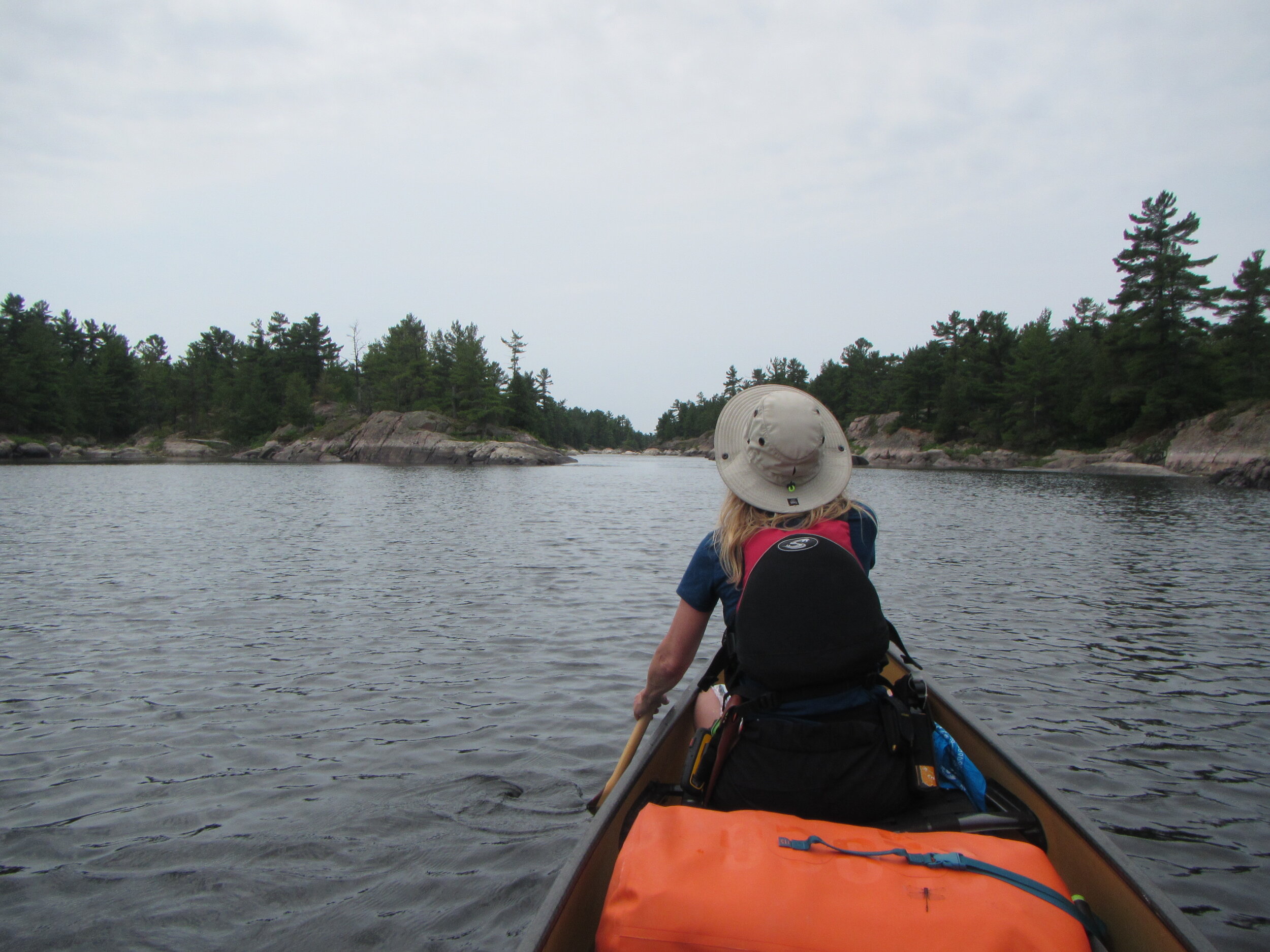
I rise this morning wondering what will happen with my day. I was going to be in a canoe today with a new friend I feel I’ve known over a lifetime, but the weather is shaky and she is recovering from a nasty bout of covid. I’m still tired from the canoe trip, too. Not fully unpacked physically or mentally.
This weekend we stayed out at Ghost Lake. Each day we threw sticks for Athena in the icy water and she retrieved them, over and over.
Last night we viewed some of the videos we’d taken during our summer canoeing excursions. Day three in Quetico (August 3), I talked about what I was afraid of (big wind/waves) and all the things I love: mushrooms, trees, water, wind, waves.
Last night I fell asleep to recorded forest sounds playing through my phone. I dreamed of standing on a shore, looking out over an expanse of water. No longer afraid. Now, waiting. I don’t know what I’m waiting for…

Ghost Lake shoreline with Theia.
Why do I canoe?
I ask myself this question often. Over and over I choose canoeing. Why?
I love canoeing so much, I want to “sell it” to everyone else. Why?
Here are some answers:
Level 1: Canoeing is adventure, healthy adventure. #72hoursinnature #significantlyreducesstressmarkers
Level 2: Communication required. Trust. Confronting fear. #healthyrelationships #facingfear #lifegoals
Level 3: Relationships with every thing is possible. #weareallconnected
Level 4: Today’s response: I canoe to make space in my existence for something else. Out of the routine of most of my days, I am in flow with the water, the wind, the land and the sun. In these moments, something else arises. The something else is a deepening relationship with the world. Each of my senses is tuned to capture more broadly, more deeply, the essence of what is. #whatishappeningtome #mindblowing
My context: I’ve spent many years attempting to fix what was wrong: with myself, with others. Self improvement seemed like the educated, eventually happy, woman’s path. Her hero’s journey was improving herself– everyone knew she was a hero just by looking at her: the clean house, glowing skin, fit body, successful children, gorgeous garden. Much of my life has been dedicated to shaping a version of myself others would love, respect, honour. Decades and decades of living, I felt I was being observed and each of my actions evaluated as good or bad. I frequently repeated as an antidote to the frenzied circling in my brain of all-the-ways-I-am-not-enough, “I love you. I love you. I love you.” I learned this from Oprah. An act of defiance against the observer.
Even though I thought saying I love you affirmations were likely bullshit, I didn’t have many other options.
Back then, I fell into bed at night, exhausted from the self-improvement practices, grateful for sleep to take over my mind and find some freedom from the watcher.
In taking care of others, I found an expression of self with the least amount of tension. My self fell away during the times I was needed- cleaning up children’s vomit, listening to a friend’s catastrophic life chapter, pursuing my employer’s objectives to change the world without realizing the falseness of their promise.
During these acts of giving my attention to others, I didn’t think about my stringy hair, my too-thin lips, the changing shape of my body. I didn’t worry about washing the floor each day, eating low fat food, worrying about money. When I was taking care of others, I didn’t exist.
I thought my care of others would lead to freedom.
I feel ashamed to say the truth: I hoped others would proclaim their love and devotion to me, so loudly and so clearly and so unconditionally, I would be able to relax into their love and not have to improve anything. I could simply be.
I canoe because it is a world where I can be without the noise of self-improvement, where the calling to help others quiets. It’s a world where my attention is tuned to the connection between the small me and greater possibilities of existence. Beyond self-improvement lies freedom. I find it in a canoe.
I read the poem Clearing by Martha Postlewaite this morning. I remembered how my need for self-improvement faded away the more time I spent in quiet with myself. I wonder if stillness is a kind of clearing in a forest?
Still in progress, I offer ideas for the reader’s consideration. I don’t know why. I am on the shore, perhaps, or in the forest clearing. This is my song this morning. I don’t need to improve it. Just notice, observe, and move from experience to experience.
Clearing
Do not try to save the whole world or do anything grandiose.
Instead, create a clearing in the dense forest of your life
and wait there patiently,
until the song that is your life
falls into your own cupped hands
and you recognize and greet it.
Only then will you know how to give yourself
to this world
so worthy of rescue.
~ Martha Postlewaite

What helps me write while I am living a writers life:
Curiosity helps. Wanting to notice, to observe, to question is like an intention for the day. It’s saying, I’m going to gather what I can from whatever I find growing today.
Stillness helps. Feeling still is the surest way to recover from anxiety about not writing enough, writing that sucks, writing you’re sure is brilliant but will never be published. Stillness is a ritual. To still the body and to rest while still is like laying on your back next to your bestie and staring into the big sky. You can’t help but feel all is okay. Such relaxation allows you to notice the strong evidence- in this moment, you are okay.
Love helps. A heart-felt, open-hearted way of living life helps me write. I no longer flinch at the bad actors I’m writing about. I am not afraid of them. I see them as opportunities for me to explore shadowy ways of living. All experiences are valid. I want to feel all of this shadowy horror through story. Humans, my ancestors, have lived through horror. Their ways of knowing are unknown by me, but I know the scale of human experiences includes war, murder, rape, violence, love, sacrifice, honour, respect. I am not punishing myself. I am not attempting to gain anyone’s favour. I’m doing what I think love does. Through the experience of love we come to know what it is and what it isn’t and how our species is affected by love’s discipline, by reciprocal relationships, by respect, by holding space for the sacred. To tell the story of love is to infuse love into the current of our existence. Currents: Water. Wind. Energy.
Although I rarely allow them anymore, deadlines for producing a specific piece of writing for a specific audience help build momentum for writing. I only allow them as a last resort– a final part of the writing process . I experience life. I notice things. I write pieces of text. I dream. I write pieces of text. One day I notice what I’ve been writing. I see a thread from one idea to the next. I sit down to write- new blank page- and the words fall into sentences and arrange into paragraphs.
Singing helps. I don’t sing while writing. I sing while walking or doing dishes or paddling the canoe. Hearing myself sing helps me get used to the sound of my voice. When I read work aloud, I hear the rhythm when it flows and when it’s stopped.
Experiencing Life. I try to be present to the experience I am in. Deep noticing and observing while in participation with life helps to build momentum towards reflection. Reflection is more about making connections between ideas and experiences and less about trying to remember, specifically, what happened. “Making Connections” is a key element of Maxine Greene’s pedagogical philosophy, Aesthetic Education. I see making connections as a process of noticing the emergence of something, not creating towards a pre-determined outcome.
A note on form: I have noticed the six points I’ve made above all have an impact on the forms my writing takes. I often “braid” or “weave” seemingly disconnected ideas together. Sometimes I write a flow of consciousness. Sometimes I want my writing to sound like a symphony. Deadlines can bring unity and cohesion to my work. I stress at transitions in the final stages of my writing. Is sense-making possible?
Note about photo: Taken from The Cabin at Cabin Falls. A place of wonder. A place of peace. A place of transformation.
Mar’ce Merrell, Ghost Lake, Alberta